
Not A Subscriber?
Join a global group of ambitious readers on their quest to understand themselves, life, and business
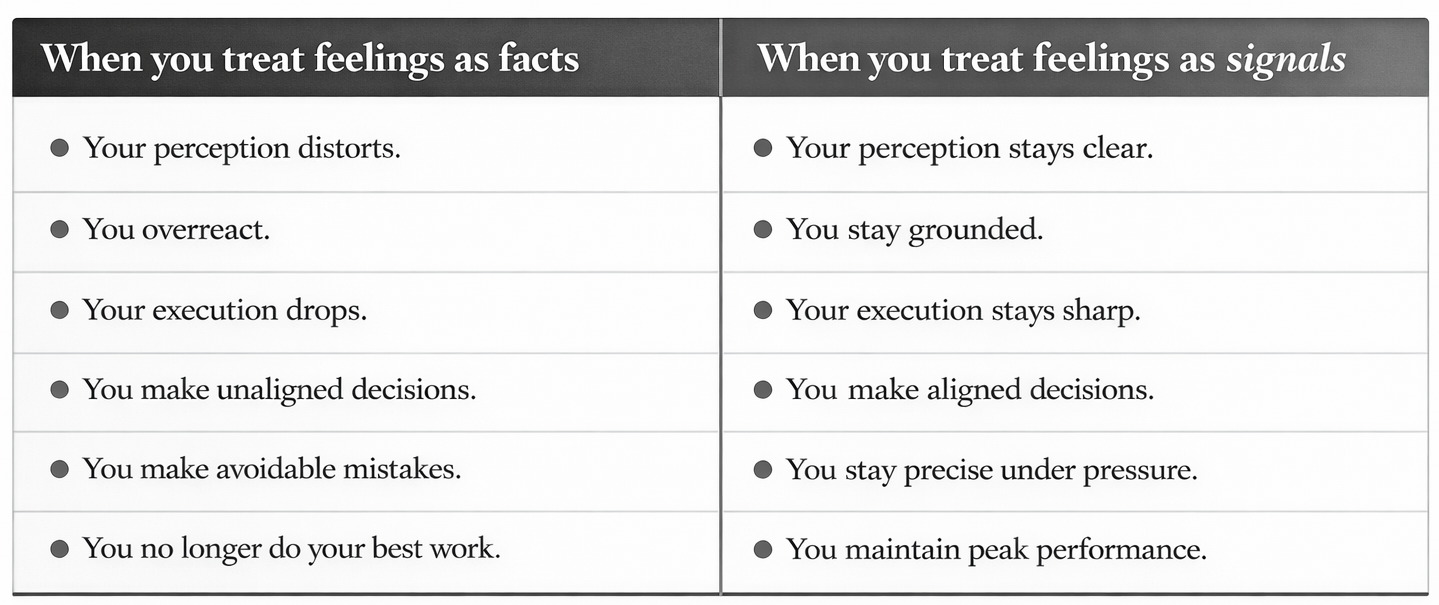
Feelings aren’t facts. They’re signals.
You can feel competent one moment and completely thrown off the next.
Logically, you know you’re good at what you do. You’ve trained for this.
But under pressure, doubt, fear, or panic can still spike out of nowhere.
Without redirection, your mind treats these feelings as reality.
This is where performance unravels.
This can happen to anyone playing at a high level. I’ve seen it in leaders, creators, operators, and consultants, and I’ve experienced it myself.
I’ve developed a 4-step process anyone can use to maintain peak performance under pressure.
But first, we need to talk about why it’s crucial for high performers to internalise this truth:
Your feelings aren’t facts. They’re signals.
Why this matters in high-stakes environments
Many of us assume the leaders among us are the most level-headed.
But often, the opposite is true.
The higher the stakes, the more your nervous system floods you with emotional chemicals.
Your chest gets tight. Your mind goes blank.
Adrenaline surges through your system.
Even something small can trigger the feeling that something is about to “go wrong,” just because you’re feeling the pressure.
We’ve all had an experience like the one I had early in my consulting career:
I remember once during a project, when a senior partner emailed me.
“Call me, we need to talk.”
No other context.
I called right away. No answer.
So I spent the next 30 minutes in a panic.
My heart raced, and my mind played out worst-case scenarios. My stomach literally hurt from contracting so much.
While waiting for him to call back, I wasn’t thoughtful, strategic, or productive. I was consumed by emotional predictions that had nothing to do with reality.
When he finally called, the conversation was routine. He wanted some context about a meeting the next day. There was no threat whatsoever.
But my reaction assumed there was, and it completely derailed my performance.
This is the cause of most mistakes: misreading your internal signals as reality.
This is the real differentiator between people who perform exceptionally under pressure and those who crumble.
What “feelings aren’t facts” actually means
I’m not telling you to suppress emotion or pretend to be unaffected.
The goal is to relate to your feelings in a more accurate way.
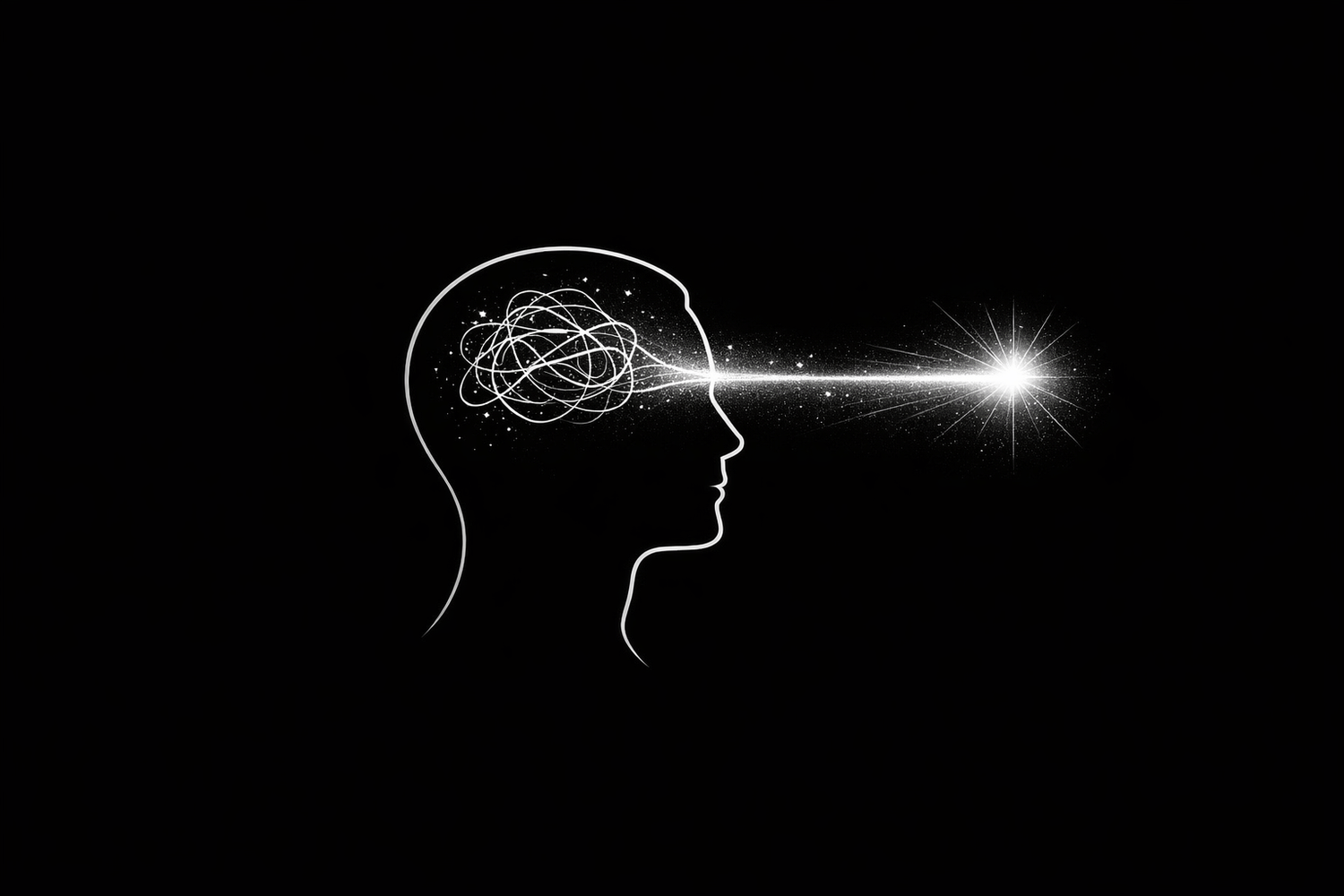
A feeling is a prediction, not necessarily a truth.
It’s your nervous system’s first attempt to make sense of a situation.
But these internal predictions aren’t the full picture. They’re based on old patterns and half-baked assumptions, not on what’s actually happening.
The feeling is real, but your mind’s interpretation is almost always incomplete.
You feel pressure → your body predicts danger.
You feel doubt → your body predicts rejection.
You feel urgency → your body predicts loss or failure.
The emotion is useful information about your internal state: what you value or fear.
But it doesn’t always offer an accurate picture of reality.
The goal is to create distance between yourself and the feeling, so you can observe what it’s signalling without letting it hijack your performance.
From here, you can get curious and explore the situation with a clearer head. Maybe your feelings are telling you the truth, maybe they’re not.
Focus on what you know to be true, not what you assume to be true.
Want more like this?
Subscribe to the Perspectives newsletter.
Why emotions rise under pressure: the science
Your brain is a meaning-making machine.
But its primary job is survival, not accuracy.
It constantly scans your environment for anything that might represent a threat: uncertainty, status risk, misalignment, or the possibility of physical harm.
And because it’s trying to protect you, it fills information gaps with whatever data it has available: your past experiences, current stress levels, workload, sleep quality, and other context.
This threat-detection system served an important evolutionary purpose.
But in the modern world, it taxes our nervous systems.
The pressures of daily life lead to false positives: moments where your body reacts as if something is dangerous when it isn’t.
If your nervous system senses danger, even in error, it fires off an emotion to get your attention.
Because the system would rather overreact than sacrifice your safety.
Under pressure, this process becomes faster but not more accurate.
That’s why emotions feel stronger in high-stakes situations.
Your nervous system interprets increased pressure as heightened risk.
Unless your life is truly at risk, most “strong feelings” aren’t reality. Even if they are directionally correct, they’re often blown out of proportion.
They’re just your system flagging something that needs attention.
Understanding this keeps your perception clean.
The reframe: feelings as signals
How do you get better at interpreting feelings as signals rather than facts?
Start by recognising that every emotion contains useful information:
Frustration → Something important is blocked.
Anxiety → Something is uncertain or undefined.
Overwhelm → Your system is overloaded or poorly prioritised.
Irritation → A boundary is being crossed.
Apathy → You’re out of alignment or under-challenged.
The reframe is simple: These feelings tell you where to look, not what to do.
Read the signal instead of obeying the feeling.
That’s how you regain clarity and precision in high-pressure situations.
The practical 4-step process to stay in your optimal execution state
After years of operating in high-pressure environments, here’s what I’ve realised:
High performance and high reactivity can’t coexist.
To execute at your best, you have to observe your feelings without being drawn into them. You have to maintain the ability to choose your response.
This is the process I teach leaders and teams for maintaining peak performance under pressure.
1. Pause for 5-10 seconds
This interrupts the impulse to react immediately to a feeling.
It creates space between the emotion and your choice of response.
2. Label the emotion (internally)
Giving the feeling a name moves your mental activity away from the reactive parts of your brain and into the executive centres.
3. Decode the signal
Instead of asking, “Is this true?” which keeps you attached to the emotion, ask:
“What is this pointing to?”
4. Choose the response that best supports your immediate next steps
Separating yourself from the emotional surge means it no longer drives you.
Instead, you’re using the data inside the emotion to understand what needs your attention.
You’re free to make the choice that best supports your next steps.
This is how you maintain focus even when the stakes are high.
Why does this elevate performance?
Using this process helps you shift out of survival mode, so you regain access to the discernment and skills to perform at your best.
You no longer burn energy reacting to your emotions.
Instead, you preserve the cognitive bandwidth required for high-quality thinking.
Here’s what happens when you consistently relate to your emotions with this level of awareness:
You maintain precision under pressure.
You have the clarity to see what’s essential and ignore what isn’t.
You stop wasting energy on emotional noise.
Instead of wrestling with your feelings, you save resources for what truly matters.
You get better at complex problem-solving.
You free up mental space for sharper insights and more creative solutions.
Your handle conflict better.
You are comfortable with strong emotions (self or others) and can work through them.
You recover faster from setbacks.
Self-awareness replaces self-judgment. You adapt quickly rather than spiralling.
This is the path from reactive execution to elite-level mental performance.
The real upgrade
You don’t need fewer emotions.
You need a better relationship with them.
When you start treating your feelings as signals, you give yourself a gift: the ability to choose how you proceed.
Your emotions become useful information, rather than commands to obey.
Without that emotional interference, you’re grounded, clear, and harder to shake.
And that’s what allows you to operate at your highest level when it matters most.
If you want to go deeper, I teach advanced tools to help you manage your emotional energy inside my course, Inner Edge.

About the author Nicolai Nielsen
I am the bestselling author of 3 books, former McKinsey Academy Associate Partner, and the founder of Potential Academy.
My mission is to raise global consciousness through education and inspiration.


© Nicolai Nielsen 2025