
Not A Subscriber?
Join a global group of ambitious readers on their quest to understand themselves, life, and business
The four layers of inner peace
What do you really want beneath all the striving?
More income? Better title? A six-pack?
No.
You want inner peace.
Happiness is fleeting. It comes and goes with wins and losses.
But inner peace? That's a deeper sense of contentment that remains stable regardless of what's happening around you.
Chances are that you’ve never really focused on how you can cultivate inner peace in practice.
It’s vague, you’ve never learned how to do it, and it’s easier to keep pushing on things that are more visible like external achievements.
Misconceptions about inner peace
There’s a lot of surface-level advice about peace that focuses on accepting things as they are, not wishing things were different, and to surrender.
At a fundamental level this is correct, but I find it too simplistic to be actionable.
Real inner peace is more nuanced and more human.
Here are 5 typical misconceptions about it.
Misconception 1: Inner peace means feeling calm all the time
Wrong.
A peaceful person still feels everything, like joy, sadness, anger, disappointment, excitement, self-doubt, and grief.
You will still feel triggers.
You will always have moments of discomfort.
But inner peace is the ability to feel fully without being overwhelmed. And to allow yourself to sit with discomfort without running from it.
Misconception 2: Peace = passivity or lack of ambition
I get this question a lot. How do peace and striving go together? How can you accept reality the way it is while still strive to change it?
Peace isn’t sitting on a mountain doing nothing. You can be deeply ambitious, fully engaged, and fiercely driven and still be at peace.
The difference is the energy behind the ambition. When you’re at peace, you don’t chase goals out of fear, proving, or insecurity. You create because it’s who you are and it’s your way to be of service.
Misconception 3: Peace happens when life is finally “sorted out”
It can be tempting to believe that everything will fall into place internally once everything in your life has been fixed and taken care of.
But unless you are in genuine danger or fighting for basic survival, peace is not something you earn by fixing the outside world first.
Peace is an inner capacity, not an outer condition.
You have two choices:
Wait for life to be perfect. Or be at peace with life as it is.
The first postpones peace forever. The second is available right now.
Misconception 4: If you have inner peace, you are always “nice” and agreeable
Being at peace does not mean you are unbothered, detached, or indifferent.
You still care. You still have boundaries. You still say no.
The difference is that you engage without inner friction.
Sometimes you need to put your foot down, to honour what is true and right.
You just do it from a place of love and compassion.
The zen teacher still insists that students take off their shoes before entering the meditation hall and will enforce this gently if someone disagrees.
Misconception 5: Inner peace is only about spiritual peace and letting go
There’s a popular idea that inner peace is purely spiritual.
That all you need to do is surrender, meditate, trust the universe, and let go.
And yes, spiritual peace matters deeply. The ability to soften, surrender, and rest in awareness is powerful.
But we are still human beings with a physical body. Regardless of what you believe about consciousness and souls, we have a nervous system, emotions, thoughts, needs, and a physical body.
You can’t “spiritually bypass” your way into lasting peace.
If your nervous system is overstimulated, if you’re sleep deprived, if you feel unsafe in relationships, if you’re overwhelmed, and if your life is out of alignment with your values, then you will not feel lasting inner peace.
No amount of surrender mantras will fix a dysregulated body, unprocessed emotions, an unclear mind, or a life that isn’t congruent.
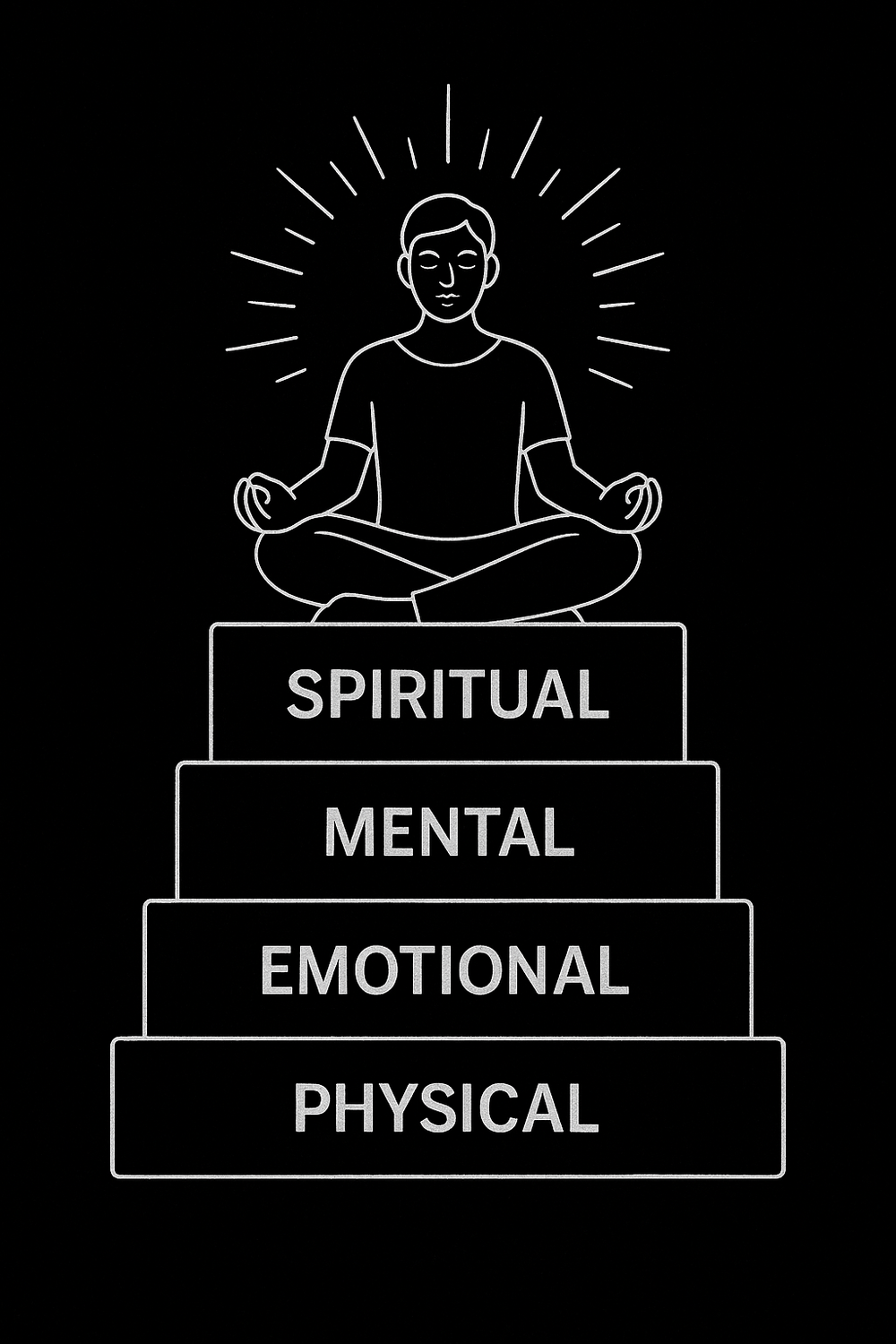
The 4 layers of inner peace
Inner peace isn't one thing. It's four layers working together: Body. Heart. Mind. Soul.
Here's how to cultivate each one.
1. Physical peace (the body)
Physical peace is the foundation. If you are sick or physically injured, your first priority is always to get back to physical health.
Physical peace comes from feeling energised, strong, and capable. When your physical needs are met, you feel grounded, resilient, and able to engage fully with life.
Without physical peace, everything else becomes harder.
Things that block physical peace: Chronic stress, poor sleep, constant stimulation, lack of movement, dehydration, poor nutrition, and things that harm the body like smoking and alcohol.
Practices to cultivate physical peace:
Consistent sleep in a comfortable bed
Nourishing meals that respect your body
Daily movement
Building strength and aerobic capacity
Treating your body with gentleness, e.g. stretching, warm showers, touch
Sunlight and nature
Breathwork
Sufficient recovery and balance
Practicing gratitude for your health, your strength, and your senses
2. Emotional peace (the heart)
Emotional peace is the feeling of belonging, acceptance, and love. It comes from emotional safety, self-acceptance, healthy relationships, and the confidence that you can handle whatever feeling arises.
When you feel emotional peace, emotions move through you cleanly rather than being suppressed or acted out impulsively.
Without emotional peace, your heart can feel tight or closed. Emotions often get stuck and small triggers create outsized reactions. You often feel numbed out or overwhelmed.
Things that block emotional peace: Suppressing feelings, unresolved emotional wounds, emotional avoidance, lack of boundaries, people-pleasing, and fear of being vulnerable.
Practices to cultivate emotional peace:
Naming emotions without judgment
Let yourself be seen and loved
Asking for help when you need it
Understanding your deeper triggers
Self-compassion practices
Building and maintaining boundaries
Honest conversations
Breath + body awareness during emotional triggers
Allowing feelings to complete without rushing to fix them
3. Mental peace (the mind)
Mental peace, or peace of mind, is a mental state of tranquility and calmness that is free from worry, stress, and anxiety. You are focused on the present moment and trust in your ability to deal with whatever happens in the future. When this layer is stable, you feel grounded and present. As a result, you are able to focus fully on whatever it is you set your mind to and express yourself creatively.
Without mental peace, you feel overwhelmed. You overthink things, are unnecessarily stressed, and often worry about the future or dwell on the past.
Things that block mental peace: Overthinking, “becoming” your thoughts, constant digital stimulation, unclear priorities, too many commitments, multitasking, and trying to control things you cannot.
Practices to cultivate mental peace:
Meditation or intentional stillness
Observing your thoughts from a distance throughout the day
Pausing before (re)acting
Simplifying your life and your priorities
Reducing digital noise
Focused work blocks + deep work practices
Using your strengths on a regular (daily) basis
Replacing self-judgment with curiosity
Speaking to yourself the way you would speak to a friend
Ending each day knowing you moved meaningfully toward your goals
4. Spiritual peace (the soul)
Spiritual peace is the deepest layer. It comes from surrender, humility, and connection with your deepest self. When you have spiritual peace, you understand and feel that everything is okay just the way it is, and that nothing needs to change.
Without spiritual peace, you grip life tightly. You fear uncertainty, try to control outcomes, over-identify with achievements, and live as if peace is contingent on life going your way.
Things that block spiritual peace: Attachment, ego identification, existential fear, resistance to reality, trying to control everything, losing perspective, and disconnecting from meaning.
Practices to cultivate spiritual peace:
Deep meditation or prayer practices
Sitting in stillness to simply be
Experiences that give you a sense of awe
Living in alignment with your values (this requires courage)
Letting go rituals
Reflecting on impermanence and death
Gratitude
Acts of compassion without expectation
Zooming out and reflecting on our tiny planet in the vast universe
Bringing it all together
Inner peace isn’t a single skill or switch you flip.
It is a holistic way of being that touches your body, your heart, your mind, and your deeper awareness. You need all four domains activated at the same time to feel fully at peace.
Living with inner peace is a choice. It’s cultivated through small, consistent actions, such as how you treat your body, the way you breathe in stressful moments, the boundaries you hold, the thoughts you let go of, and your ability to see life with perspective.
The invitation is simple: Sense which area of your life feels tense or out of sync, and then take deliberate steps towards rebalancing that area.
You won't wake up one day and suddenly 'have' peace.
It's a choice. An ongoing practice. A way of moving through life.
Set the bar high and commit to peace as your default state.
Once you cultivate this, everything else flows.

About the author Nicolai Nielsen
I am the bestselling author of 3 books, former McKinsey Academy Associate Partner, and the founder of Potential Academy.
My mission is to raise global consciousness through education and inspiration.


© Nicolai Nielsen 2025