
Not A Subscriber?
Join a global group of ambitious readers on their quest to understand themselves, life, and business
The good-to-great gap no one talks about
A few years ago, I could clearly describe the next version of my life.
It was one with more freedom, more creative control, and more time to think, write, and work on what truly mattered to me.
Intellectually, it made complete sense. Strategically, it was sound. I could even map the steps.
And yet, it didn’t feel real. The vision itself wasn’t enough to motivate me.
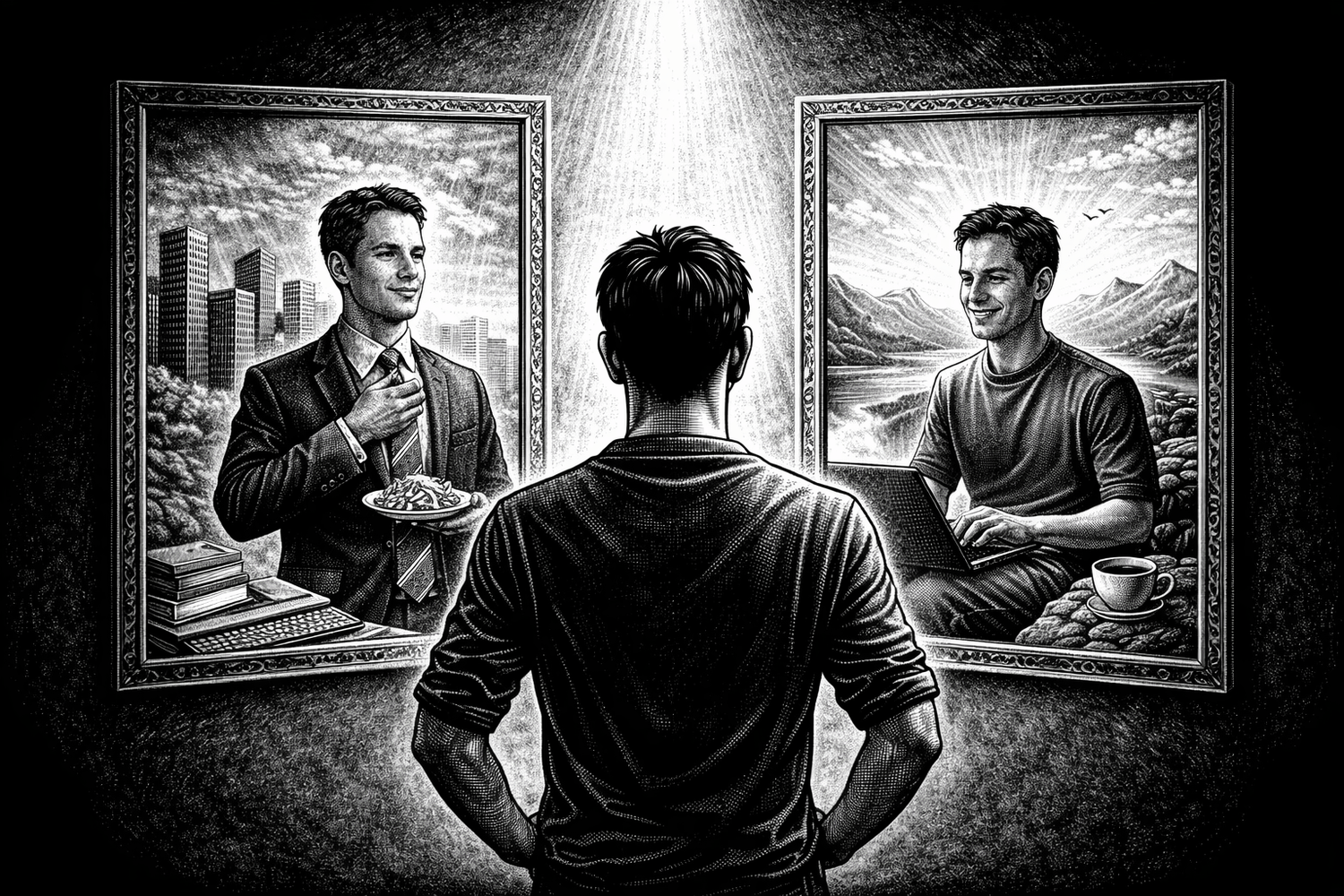
It was more like watching someone else’s life through a window.
I didn’t doubt it was possible. I just couldn’t feel myself in it yet.
That gap between knowing something is possible and actually believing it at a deeper level is something I see constantly in high performers.
I call it the good-to-great gap. And it’s misunderstood.
It’s not confusion or fear. It’s not even a mindset issue.
It’s what happens when your future is genuinely foreign to your current way of living and experiencing yourself.
Your ambition is there, but your conviction hasn’t caught up.
Let’s talk about how to close that gap, so you can go from strategic vision to embodied belief.
When you have clarity, but it still doesn’t feel real
Many coaching clients come to me with a vision for a future they don’t fully believe in yet.
Manifestation says you need to energetically embody that future state — to see, hear, feel, taste and smell that reality.
They can't. Something is blocking them.
They’re performing well in their current environment.
What got them here still works.
But it won’t take them where they want to go.
Maybe you’re experiencing this now:
You can see the “next level” clearly. But it seems too good to be true.
This is where a lot of people assume they have a mindset problem.
They try to override the disbelief with affirmations or positive thinking.
That often fails, and then they make the problem personal.
Why can’t I just commit?
Why can’t I just believe?
Why does it feel impossible when it is logically possible?
What’s wrong with me that I can’t make it happen while others can?
Here’s what’s creating this good-to-great gap:
The future you want requires a different energy and identity.
But your current habits and environments reinforce the present version of you.
Your imagination runs ahead of your lived experience.
Which means:
The future stays conceptual, and conviction feels forced.
So you swing between excitement and detachment.
You feel motivated one day and flat the next.
The vision becomes something you admire rather than something you inhabit.
Mentally, you’re there. But you need to embody the vision to start living it.
Want more like this?
Subscribe to the Perspectives newsletter.
What’s actually happening cognitively and emotionally
The gap from good to great is frustrating. You’re ambitious, so why do you feel stuck?
Here’s what the good-to-great gap looks like on cognitive and emotional levels.
Cognitively:
Your mind understands the logic.
But it lacks concrete internal examples.
It needs familiar reference points to build out the vision.
Without lived, emotional evidence, the future stays abstract.
You see it happen for others, but your mind doesn’t know how this vision feels for you to live.
Emotionally:
Your nervous system says:
I’ve never experienced that. I don’t know if it’s safe. I don’t know if we can handle it.
There’s no memory-based resonance. So it feels distant, like a story told about someone else.
This is why affirmations don’t work.
You can’t think your way to more familiarity with something you’ve never lived.
A future becomes believable when you have reference points that tell your system:
This kind of life exists.
People like me can live it.
I’ve already started becoming the person who lives that way.
Until then, the future remains an idea.
And ideas don’t create momentum in the body. Experience does.
Every time I reached a new level in life, there was a gap I had to overcome.
When I got my first "A" grade in university, it felt too good to be true. Then it became my new baseline. I experienced the same sensation when I got into Wharton, got an offer to join McKinsey, and when my wife and I moved to Italy. Each time the step felt "too good to be true" for a while, and only after it happened did it truly feel like the new normal.
At each stage I had to endure a period of discomfort, not knowing whether what I yearned for was really possible. Each step required a proverbial leap of faith.
However, there are certain patterns I've noticed that can help when you find yourself in a similar situation.
Practical guide to making the future feel real
When you’re stuck in a reality where you're working hard but not fulfilled, it’s hard to imagine yourself in a different situation.
How can I be successful in an executive role and be relaxed at home?
How can I deliver at work without working that much?
How can I achieve everything I want to do and still have energy?
If you can see the future you want, but it’s hard to connect to emotionally, you’re in the good-to-great gap. Here’s how to close it.
Step 1: Normalise the disbelief.
Start by telling yourself:
Of course it feels unreal. You’ve never lived that way before. Your system has no reference point.
This removes shame, which is important because shame makes you contract. And contraction kills exploration.
The gap merely shows that the future you want is different from anything you’ve ever known.
That’s the point.
Step 2: Shift from believing to exploring.
I help my coaching clients release specific outcomes and focus on curiosity.
Replace “Can I have this?”
With “What would it be like to explore this direction?”
It’s a subtle shift in energy, but your nervous system can tell the difference.
The first question feels like a test.
If you can’t answer confidently, you shut down.
Exploration doesn’t do that, because it doesn’t require certainty.
It just asks you to start moving and stay curious.
Try these reframes:
What if this isn’t a destination, but a direction?
What’s one step toward this that doesn’t require certainty?
What version of my week aligns with this future?
This exploratory thinking reduces threat by making the abstract more tangible.
It helps you gain clarity and direction without attachment to the outcome.
Step 3: Use parallel lives.
This is one of the most effective tools for making a future believable.
Ask:
Do you know anyone living a version of this life?
Try to make this someone you can actually observe. Not someone you follow online.
If yes, ask:
What do you admire about them?
What’s surprisingly ordinary about how they live?
How do they structure their days?
What do you tell yourself about why they can have it?
This last question is especially important.
Because it exposes the deep belief keeping you from connecting to the future you want.
Maybe that belief is:
They’re more disciplined.
They had a head start.
They’re more confident.
They’re built differently.
The belief is untrue, but it has power over you.
What’s usually true is simpler:
They took steps long enough for the steps to become normal.
Seeing others live a version of the future makes it feel real.
Proximity matters more than inspiration.
Seeing a life up close (that it’s real, it has normal problems, normal trade-offs, and normal rhythms) removes the fantasy layer.
And fantasy is what makes the future feel unreachable.
Step 4: Identify the identity delta explicitly.
Your identity delta is the gap between:
- Who you’ve learned to be so far, and
- Who your next level would require you to become.
Don’t let this stay abstract. Make it concrete.
This is the real work.
Ask:
What would it mean about me if this actually worked out?
Which part of me might be threatened if I allowed myself this life?
What part of me says, “People like me don’t get that?”
There’s almost always an outdated rule that needs rewriting.
For example:
I must earn rest.
Success requires suffering.
I don’t get to enjoy life that much.
I’m not that kind of person.
Name the rule. Shine a light on it.
That’s where your work is.
Step 5: Compress the time horizon until it feels real.
High performers often think too far ahead.
They imagine the future in 2–5 year blocks.
But if the future doesn’t feel real, years are too abstract.
So stop thinking in years.
Think in quarters or months.
Ask:
What would a credible next 90 days look like?
What version of me do I believe I can be by then?
Believability precedes scale.
The future starts to become real when you can feel the next steps towards it.
Step 6: Run small, high-fidelity experiments.
Don’t worry about “becoming” that future self. You’re just going to start living pieces of it.
One of my coaching clients co-founded a venture capital company while working a 9-5. His work was fun, but required a lot from him.
We identified a simple thing he wanted but felt impossible:
Playing golf on a Friday afternoon.
His mind said: That's just not what you're supposed to do.
Letting himself take that step anyway helped him expand toward the reality he wanted.
Here are some small experiments you could try:
- Live that future life one day this week.
- Change how you structure mornings or work blocks.
- Remove one thing that clearly belongs to the old level.
- Create one non-negotiable that matches the future identity.
- Make one decision you’ve been postponing because it feels “too good.”
The rule of thumb here is simple:
Experience creates emotional proof.
Emotional proof creates conviction.
Conviction is built, not decided
You can’t bridge the gap between good and great by simply having a better mindset.
Even if you're the best in the world at what you do, you still have a comfort zone. Pushing past it still requires constant leaps of faith. You still have to act before you fully believe the next goal is possible.
What helps you close the gap — embody the new reality before it feels real — is generating reference points you can feel. Creating familiarity around the unfamiliar.
Normalise the future you want until it becomes your present.
The future doesn’t become believable because you think harder.
It becomes believable because, step by step, it starts to feel like your life.
Want guided support for this inner work? Check out my course, The Inner Edge, to unlock your potential and build the future you envision.

About the author Nicolai Nielsen
I am the bestselling author of 3 books, former McKinsey Academy Associate Partner, and the founder of Potential Academy.
My mission is to raise global consciousness through education and inspiration.


© Nicolai Nielsen 2025