
Not A Subscriber?
Join a global group of ambitious readers on their quest to understand themselves, life, and business
Humility is the new power skill
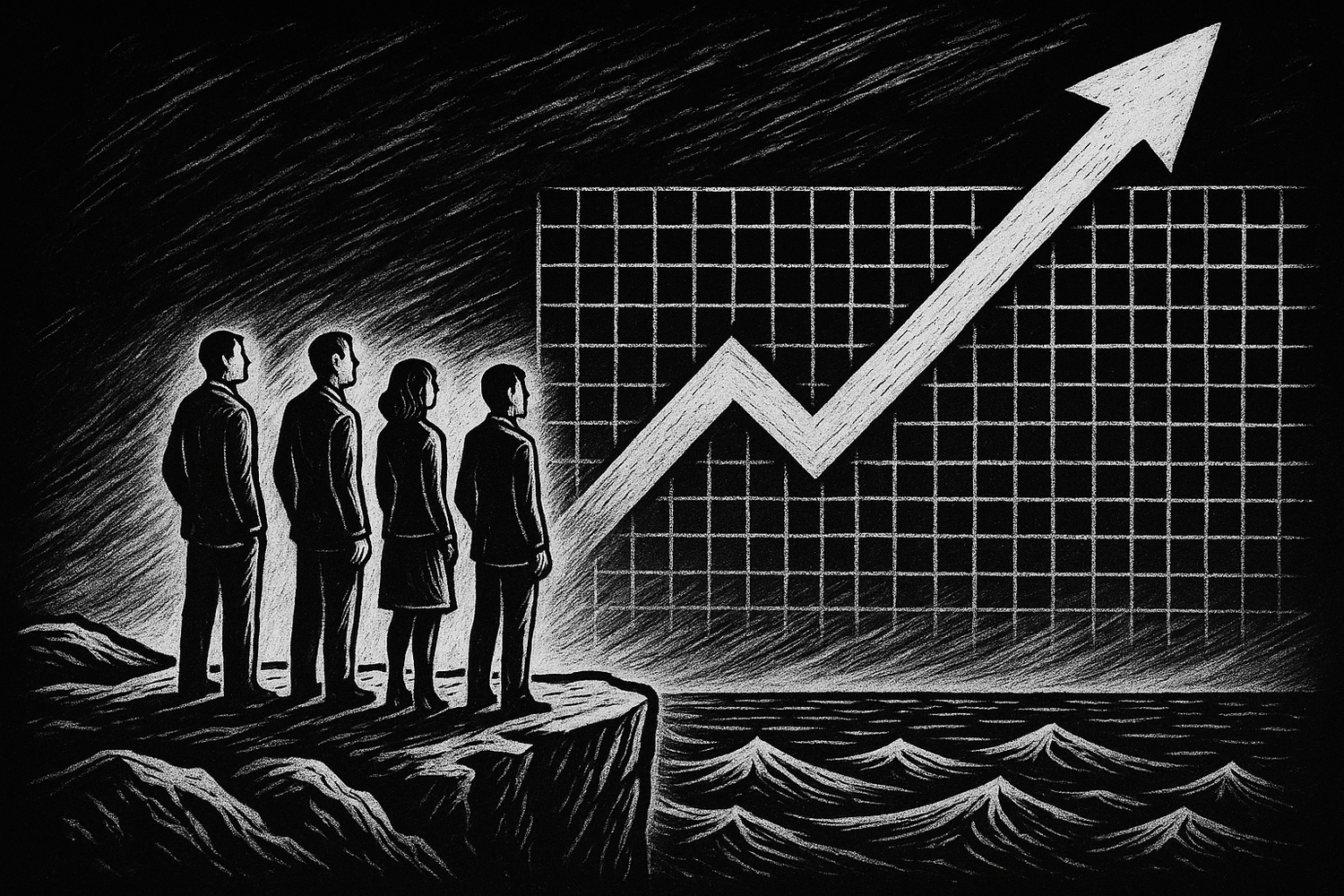
Technology is evolving exponentially.
Our inner capacity is not.
We're upgrading our tools faster than we're upgrading the humans using them.
And that gap is starting to show.
Short-term thinking. Wrong strategic decisions. Slow decision-making. Cultural breakdowns.
Brilliant people burning out at scale.
When the world accelerates faster than you do, you don't get exponential performance.
You get exponential stress.
The skills that made you successful, such as strategic thinking, execution, communication, inspiration, are still necessary.
But they're no longer enough.
We need to get to the next stage of human evolution.
One where we evolve as fast as the world around us.
The Old Playbook Is Breaking
For most of modern management history, business rewarded certainty, planning, efficiency, and control.
We trained people to optimize performance in known environments. To predict, plan, and execute.
That worked when change was slow.
It doesn't work anymore.
With the advent and convergence of exponential technologies, the world is changing in ways the human mind cannot fathom.
The human mind has a deep linearity bias. We instinctively assume tomorrow will look like today, only slightly better or slightly faster.
It’s a relic of a physical-world paradigm where change happened slowly, resources were scarce, and value was exchanged rather than multiplied.
In that world, if I gave you an apple and you gave me an orange, we simply traded.
In today’s digital world, if I share an idea and you share an idea, we both have two ideas. And because ideas stack, converge, and recombine, change is compounded and innovation is exponential.
That’s hard for our instincts to grasp, which is why we consistently underestimate the speed and scale of what’s coming.
AI agents will soon outnumber humans online. Most knowledge work will be automated. Breakthroughs in energy and fusion may drop costs to a fraction of today's levels.
When intelligence, energy, and access become abundant, the leaders who still think linearly will struggle.
The ones who thrive will be those who are able to evolve their thinking as fast as technology evolves the world around them.
The skills that AI can't replace (yet)
Entry-level work is disappearing.
Routine cognitive tasks are being automated.
The human role is shifting upward, toward creativity, system-level thinking, emotional intelligence, and deep collaborative problem-solving.
AI can produce ideas, write code, and solve complex tasks at superhuman speed.
But it still can't:
Grasp real-world context and nuance
See how systems work or understand causal linkages
Understand emergent dynamics or reason from first principles
Interpret emotion or build trust
Draw on lived experience, intuition, or ethical intent
These are deeply human domains.
This is where the future of human work lives.
The real question isn’t whether AI will replace humans, it’s whether humans will outgrow themselves fast enough to stay relevant.
Humility is the new power skill
This shift is uncomfortable.
It requires new ways of thinking. New mental models. Admitting what you don't know.
And that requires humility.
Deep humility.
The kind that allows you to say:
"My past success is not enough for the future."
"My mental models may be outdated."
"I may be wrong."
"Others know more than me in many domains."
"I need to learn, continuously and publicly."
This breaks the traditional leadership playbook.
The one built on control, authority, expertise, and unwavering confidence.
It demands self-awareness, emotional depth, curiosity, and the willingness to stay in student mode while leading at pace and scale.
Most people can't do this.
They'd rather protect their ego than evolve their capacity.
Certainty feels safer than change.
And that's why they'll struggle.
What humility actually looks like
Humility isn't an intellectual exercise.
You can't fake it by going through the motions because you know it's the "right thing to do."
Humility is a deep surrendering of control. It's sensing what's emerging in the moment. It's having the courage to adapt rather than protect.
It shows up in the questions you ask, the assumptions you challenge, and the pace at which you're willing to update yourself.
Here's how to practice it:
1. Get out of autopilot
Stop optimizing for speed. Start asking: "Am I solving the right problem?"
Most wasted effort comes from optimizing the wrong thing.
Create space to zoom out before diving in.
What this looks like: Before improving your weekly reporting process, ask if the report is even needed. Maybe a simple dashboard eliminates the work entirely. Maybe nobody reads it. Challenge the assumption that it should exist at all.
2. Apply the 10x lens
Continuously ask: How could this be done 10x faster, better, cheaper, or simpler?
This forces you to think exponentially, not incrementally.
Incremental thinking asks: "How do we do this 10% better?"
Exponential thinking asks: "How do we do this radically differently?”
What this looks like: Instead of hiring more customer support agents, ask how you can eliminate 80% of inbound requests through better product design, self-service tools, or automation
3. Use AI as a thinking partner, not just a tool
Most people use AI to speed up execution.
That’s limiting its potential.
Use it to challenge your ideas, stretch your perspective, and reveal blind spots.
Humility means being willing to find out you're wrong sooner.
What this looks like: Before finalizing a strategy, run your plan through AI with this prompt: "Attack this plan. What am I missing? What risks am I underestimating? Which assumptions should I question?" Let it poke holes. Then refine.
4. Listen to understand, not to reply
Don't listen to respond. Listen to truly understand.
Suspend your instinct to judge, defend, or problem-solve immediately.
Make room for nuance. Let others shape your thinking.
What this looks like: When someone disagrees with you, don't argue. Ask: "What assumptions led you to that point of view?" Then listen. You'll either change your mind or understand theirs better.
5. Seek feedback and act on it
Treat feedback as data.
Your ego doesn't need to be right.
Your capacity needs to grow.
What this looks like: Ask your team regularly: "What's one thing I could do that would make me even more effective?"
6. Deepen Your Self-Awareness
Reflect daily.
Notice your patterns.
Ask what emotion or underlying belief is driving your decisions.
Humility is the courage to see yourself clearly, then choose the best path forward.
What this looks like: When you feel urgency rising, pause. Ask: "Am I being driven by fear or clarity right now?" If it's fear, take a breath. Connect with your values. Then act. Fear-driven decisions are almost always wrong.
Evolving faster
The future belongs to those who operate at the intersection of advanced technology and deep humanity.
Those who update their mental models as fast as the world changes.
People who can see complexity clearly, navigate uncertainty calmly, use technology as leverage, and stay grounded in timeless human capacities like emotional intelligence, discernment, creativity, and empathy.
The people who thrive won't be the ones who cling to certainty.
They'll be the ones who stay curious, update their beliefs often, and grow as fast as the world evolves.
This rewards those willing to question themselves, expand their awareness, and keep reshaping who they are.
The more you admit you don't know, the faster you learn.
The faster you learn, the more you grow.
The more you grow, the quicker you adapt.
Stop trying to be right.
Start trying to evolve.
Darwin showed that you need to evolve to survive.
The rate of evolution has just gone up.

About the author Nicolai Nielsen
I am the bestselling author of 3 books, former McKinsey Academy Associate Partner, and the founder of Potential Academy.
My mission is to raise global consciousness through education and inspiration.


© Nicolai Nielsen 2025