
Not A Subscriber?
Join a global group of ambitious readers on their quest to understand themselves, life, and business
Inner peace is the ultimate flex
Everyone's flexing something.
The car. The title. The vacation. The follower count. The exit. The body. The relationship.
Some say the ultimate flex is time freedom: being able to do what you want, when you want.
I used to think this, and I chased time freedom for a while. But I've found that this isn't it.
You can have everything and still feel empty. You can achieve the dream and wake up wondering why it doesn't feel the way you thought it would.
Most of us know of someone who has “won” on paper and is secretly miserable.
The real flex is inner peace.
It's the ultimate form of power.
Let me show you why.
What people actually want
A mentor of mine was diagnosed with cancer and, for a time, thought he was going to die.
Before he went into remission, he did a ritual to come to terms with his death.
As a result, he found peace despite the most unfair circumstances.
I tried to replicate that ritual in my life as a way to access inner peace.
I asked myself:
If I were to die 10 years from now, would I look back on my life with regrets based on how I’m living today? What would I change?
What I realised was that I had been chasing things like money and status because of what I believed they would bring me. Things like admiration, relief, calm, and security. A sense of “life will magically be better”.
But external successes will never lead to sustained fulfilment, because our goal posts keep changing. Humans rapidly adapt to new circumstances and then start craving more.
It was only when I stopped focusing on getting "more" and started being content with "enough" that things started to shift.
This mindset shift leads to a deeper sense of contentment that stays stable no matter what's happening around you.
This might sound unattainable, but it’s not.
We all experience moments of peace, likely more often than we realise.
Playing with your kids
Sharing a meal with your partner
Leaves rustling through trees
Looking at your favourite view
Enjoying a warm drink by the fireplace
Those moments when life falls away and you feel calm, even if for a microsecond.
We’re after that feeling, but it’s rarely the focus.
Peace sounds vague. So it's easier to keep pushing on what’s visible, like achievements.
Want more like this?
Subscribe to the Perspectives newsletter.
The world runs on reactivity
Look around. Everyone's reactive, busy, stressed.
Their environment rewards it. Working on urgent tasks feels important. Dropping everything when a crisis hits feels productive. And having more rather than less to do is the norm.
Prompting reactivity can even be good for business. Drama gets engagement. Outrage gets clicks. You can even get a sense of self-worth from all this outrage, like it's you against the world.
This is what most people call “normal.” But it's not normal. It's exhausting.
Reactive people are controlled people. If your emotional state constantly changes depending on what happens to you, you're not free. You're a puppet.
And it's costing you everything.
Reactive people make bad decisions. They burn relationships. They are constantly scattered.
When you're at peace, you see things clearly.
You respond instead of react. You think and move strategically. Deliberately. Intentionally.
You start to stick out in an increasingly chaotic world.
Peace is a competitive advantage
Who wins negotiations? The person who needs the deal less.
Who builds better companies? The founder who doesn't panic when performance dips.
Who creates better work? The artist who isn't desperate for validation.
Inner peace gives you detachment. (Not apathy. Detachment.)
You care deeply, but you're not attached to outcomes. You work hard, but you're not controlled by results. You want things, but you don't need them to feel whole.
This is the paradox: the less you need something, the more likely you are to get it.
Because desperation repels, suffocates, and creates anxiety.
Peace, on the other hand, attracts.
This is why calm people are magnetic.
They just are. And people feel that.
Clients want to work with you.
Investors want to back you.
Partners want to collaborate with you.
You stand out because you’re grounded.
Peace is a sign that you've done the inner work. That you're not going to implode when things get hard. That you can hold steady when everyone else is losing their minds.
In a world of chaos, calm is the ultimate competitive advantage.
For a guided approach to this inner work, check out my course, The Inner Edge. It gives you tools and concepts to live a fulfilled life aligned with your potential.
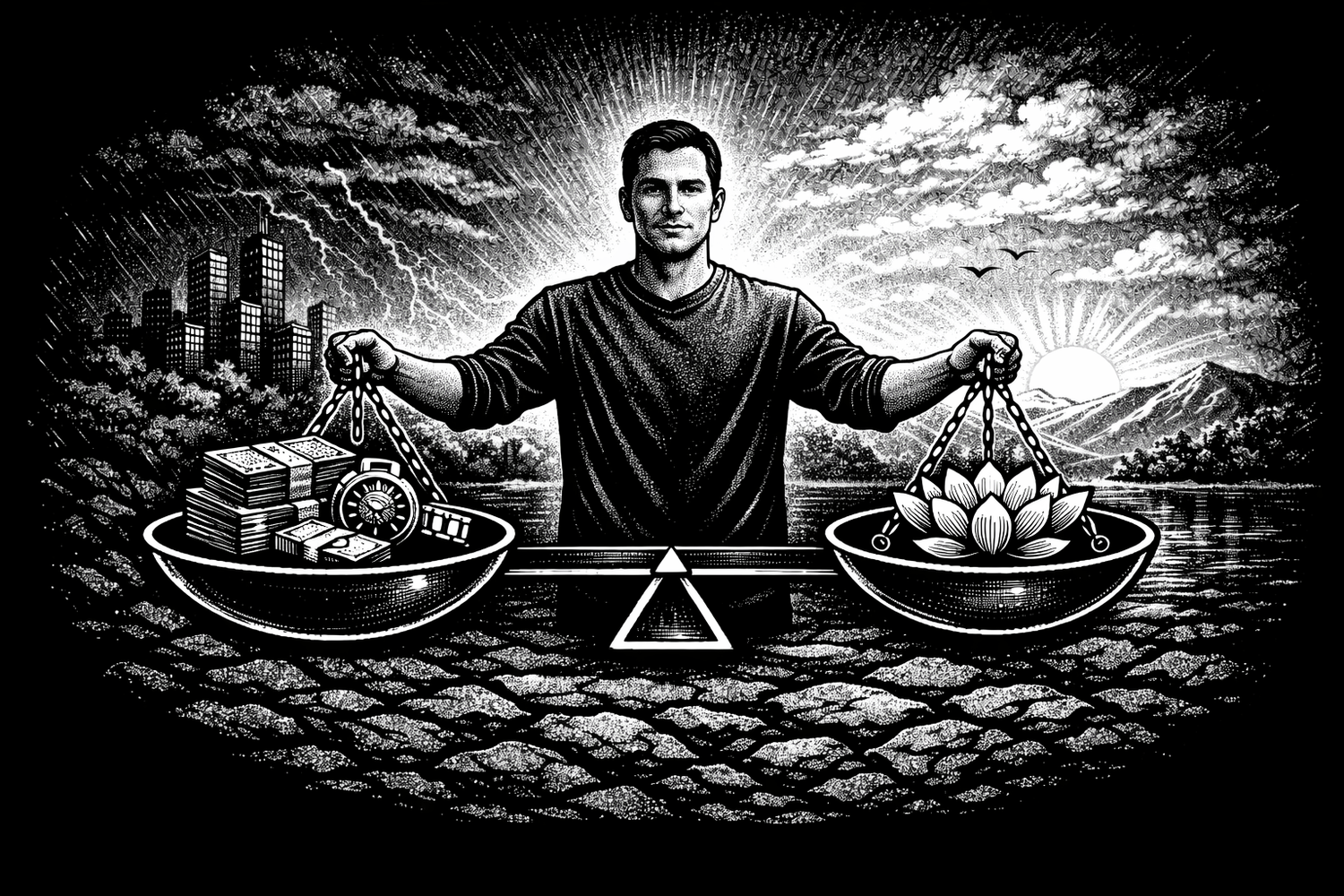
How most people chase peace (and why it doesn't work)
Most people treat peace like a destination.
Once I make $X, I'll be at peace.
Once I find the right relationship, I'll be at peace.
Once I hit my goal weight, move to the right city, finish this project, prove myself, I'll be at peace.
You know how this ends.
You hit the goal. The peace lasts 48 hours. Then the goalposts move.
That’s what happens when you chase relief from the discomfort of not having peace.
Relief isn't peace. It's just a temporary break from anxiety.
Real peace comes from internal alignment.
You can’t “achieve” it. You have to cultivate it.
How To Build Inner Peace
Peace isn't a personality trait you're born with. It's a skill you develop.
Here's how:
1. Stop outsourcing your peace to outcomes.
Your peace cannot depend on things going your way.
Life will always throw curveballs. There will always be uncertainty and disappointment.
Practice this mindset shift: I prefer this outcome, but I'll be okay either way.
That psychological flexibility gives you freedom.
What this looks like: Before a big meeting, presentation, or launch, say to yourself: “I want this to go well. But my worth isn't tied to the outcome.” Notice how much lighter you feel.
2. Create space between stimulus and response.
Most people react as soon as something happens.
Instead, widen the space between the event (stimulus) and your response.
Pause. Breathe. Then choose.
What this looks like: When you feel triggered, take three deep breaths before you respond. Ask: “Is this response aligned with who I want to be?” Then act.
3. Stop arguing with reality.
Byron Katie asks, “When you argue with reality, how often do you win?”
The answer is never.
What happened happened. What is is.
You can wish it were different, resist it, and rage against it.
Or you can accept it and decide what to do next.
Peace lives in the second option.
What this looks like: When something goes wrong and you catch yourself saying, “This shouldn't have happened” or “Why me?” Replace it with: “This happened. What now?” Watch how fast your energy shifts from victim to action-taker.
4. Regulate your nervous system daily.
You can't think your way to peace if your body is in fight-or-flight.
Your nervous system needs training.
Breathwork. Cold exposure. Movement. Stillness. Sleep.
What sounds like a luxury is necessary maintenance for sustainable functioning and peace.
What this looks like: 5 minutes of deep breathing every morning. One cold shower a week. 20 minutes of walking in nature without your phone (preferably daily). These small habits compound into unshakeable calm.
5. Let go of what you can't control.
Make two lists:
1. Things I can control
2. Things I can't control
Put 100% of your energy into the first list. Let go of the second.
Most people do the opposite. They obsess over things they can't control and neglect things they can.
What this looks like: You can't control whether someone likes you. You can control how you show up. You can't control market conditions. You can control your work ethic. Focus there.
The paradox of peace
The more you seek peace, the further away it feels.
If you're chasing peace, you're sending the message to yourself that you don't have it.
That mindset guarantees you won't find it.
Peace is something you remember and feel.
It's already here beneath the noise, the striving, and the endless mental commentary about what's wrong and what needs to be fixed.
You don't need to become peaceful. You need to stop being at war with yourself.
Stop arguing with reality. Stop needing life to be different than it is right now.
The moment you stop fighting, you find it.
Inner peace is always available to you. You are just too busy looking for it somewhere else.
The real flex
We live in the most distracted, anxious, overstimulated era in human history.
Everyone's nervous system is fried. Everyone's attention is fragmented.
In this environment, the person who stays centred has the advantage.
Peace gives you clarity when everyone else is confused.
It gives you patience when everyone else is impulsive.
It gives you presence when everyone else is distracted.
In a world optimised for reactivity, being totally at peace can almost seem rebellious.
It's the ultimate flex because it can't be bought, faked, or performed.
You either have it or you don't.
And everyone can tell.

About the author Nicolai Nielsen
I am the bestselling author of 3 books, former McKinsey Academy Associate Partner, and the founder of Potential Academy.
My mission is to raise global consciousness through education and inspiration.


© Nicolai Nielsen 2025