Not A Subscriber?
Join a global group of ambitious readers on their quest to understand themselves, life, and business
The future belongs to those who create
There’s a version of you, 12 months from now, who either thanks you for what you built today… or resents you for waiting.
Because the traditional career path is gone.
“Study. Join a company. Pay your dues. Progress.”
That world doesn't exist anymore.
Entry-level roles that teach "the basics" are disappearing. AI handles the tasks. Global teams do the grunt work. The ladder you thought you'd climb? It’s time to build its replacement.
What this means for you:
If you're waiting for the “right opportunity,” you're already behind. While you wait, someone else is building, shipping, and getting noticed.
If you think you need permission, you'll never start.
You are your only gatekeeper now.
If you're hoping your resume will carry you, wake up.
Credentials signal potential. Output signals capability.
The world pays attention to the second.
The future belongs to those who create their own path.
Let’s talk about how you make that shift, from waiting to creating.
From being chosen to choosing yourself
For decades, progress came from external selection.
Test scores decided your school. Degrees signalled your worth. Employers defined your trajectory. Success meant being chosen by a university, a manager, a recruiter, or a system.
This is the first thing to unlearn:
Institutions don’t determine your path anymore. Your output does.
Today’s employers don't have time to guess who might be valuable. They look for evidence. Momentum. Versatility. The ability to work with and through technology. People who think independently, adapt quickly, and create value without needing a roadmap.
More opportunities are there for the taking than ever.
But the question isn't “Will someone give me a chance?”
It's “What can I build that proves I don't need one?”
Your edge comes from small asymmetries, not big genius
One myth that holds people back is that you need special talent or a dramatic breakthrough.
You don't.
Your edge lives at the intersection of simple things:
What energises you
What comes naturally
What you notice that others miss
What you can do slightly better than most
Being 10% ahead in one area is enough to unlock opportunity. Because most people aren't creating anything at all.
Most are waiting. Observing. Thinking. Hesitating.
Think about the small advantages you have in areas most people ignore.
You notice patterns in data others miss. You explain complex ideas simply. You ship things while others are still planning. You're 10% better at connecting dots across disciplines.
That 10% is enough.
Your edge grows when you act. It becomes visible when you share what you've built.
What this looks like: You're decent at design and decent at writing. Most designers don't write. Most writers don't design. That intersection is your edge. Use it. Build something that combines both. Show it. That's how you become "the person who does X."
The world rewards movement.
Creation is the new currency
In a world where AI produces polished output on command, perfection has stopped being a differentiator.
What matters now is whether you can do meaningful work in the real world, and whether you can show it.
Your resume says "Marketing Manager, 2020-2023."
Cool. What did you actually DO?
Your portfolio shows a campaign that drove 10,000 signups, a content system that scaled to 6 writers, a framework other teams now use.
One tells me your title. The other shows me your value.
Portfolios. Prototypes. Experiments. Case studies. Writing. Micro-projects. Open-source contributions. Real-world outcomes.
These are the new signals of competence.
A CV lists claims. A portfolio shows what you already are.
Employers, founders, investors, and collaborators all want the same thing: proof.
Proof that you build. Think. Finish things. Create value in complexity.
If you commit to producing visible work, you immediately pull ahead of 90% of the population.
Momentum signals seriousness. Consistency signals capability. Output signals identity.
What this looks like: You're in finance. Instead of just doing your job, you build a dashboard that makes reporting 10x faster. You document how it works. You share it internally. Someone asks to use it. Then another team. Now you're "the person who builds systems." That's how identity shifts from your title to your value.
Detach your value from a job description or a single organisation.
All that matters is your ability to solve real problems, work with technology, adapt to new contexts, collaborate across disciplines, and learn faster than circumstances change.
That value travels with you. It compounds. It becomes your edge.
Why AI makes this more urgent, not less
AI can write, code, and design in seconds.
But it can't decide what's worth building.
It can't understand context. It can't navigate ambiguity. It can't build relationships. It can't ship something imperfect and learn from the response.
That's the human edge.
AI makes creation easier. But it makes creators more valuable.
Think about it: when everyone can generate content, the bottleneck isn’t production.
It’s your ability to curate. Your judgment. Your taste.
When everyone can code, the bottleneck isn't syntax.
It's knowing what to build and why.
AI amplifies your output. But only if you have the judgment to direct it.
The question isn't “Will AI replace me?”
It's “Can I use AI to amplify what I build?”
Those who can will dominate the next decade.
What this looks like: You're writing a guide. Instead of spending 10 hours drafting, you use AI to generate a rough outline in 10 minutes. Then you spend your time refining the structure, adding insight, and making it human. You ship in 3 hours instead of 10. You just 3x'd your output. That's leverage.
Clarity comes through action
When the world changes this fast, “finding your passion” or “picking the perfect path” becomes impossible.
You can't choose a 20-year plan when industries transform every three years.
Certainty has disappeared. But something better has replaced it: the ability to design your path as you go.
You figure out what you want to do by trying things, not by thinking about them.
You gain direction by making small bets, observing what resonates, and taking the next step.
Think of your path the way a founder thinks about a product:
Build a prototype
Test it in the real world
Learn what works and what doesn't
Iterate based on your findings
Move to the next version
Past generations could choose one path and that was it. Their future was set.
Not today.
See your road ahead less as a “path.” More as a sequence of experiments.
Each one teaches you something about yourself. Each one builds capability and direction.
What this looks like: You're interested in sustainability but don't know where you fit. So you write one article about carbon markets. Someone shares it. You write another. A startup founder reaches out. You consult for them for three months. Now you know more about where you want to go. You didn't plan this. You discovered it by moving.
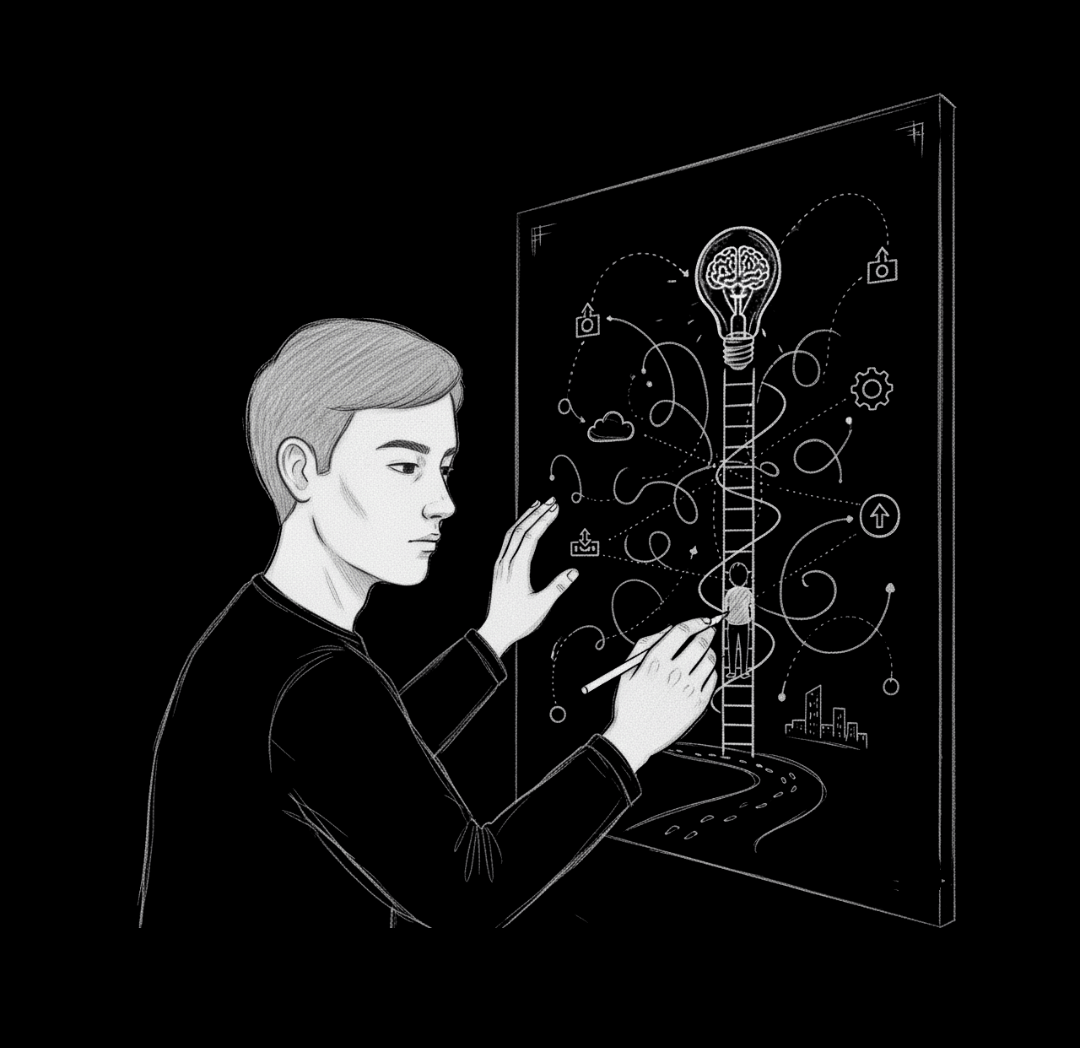
The flywheel of growth
The old formula was: Learn → Get a job → Do the work.
The new formula is simpler and more dynamic:
Learn → Build → Share → Repeat.
This is the engine of modern value creation.
You learn something new. You immediately turn it into a small piece of output. You share it with the world. You get feedback, iterate, and level up.
This is how you compound skills, visibility, confidence, and opportunity all at once.
It feels small at first. But small steps accumulate.
One article becomes ten. One project becomes a portfolio. One conversation becomes a network.
And once the flywheel spins, it creates exponential opportunities.
People start reaching out.
Your voice gets clearer.
Your taste gets sharper.
Your capability compounds.
This is how modern careers get built.
Unlearn these myths. Practice is what makes self-starters.
People often say, “I'm not entrepreneurial.”
But “being entrepreneurial” is accessible to all of us.
Every human has the capacity to create, experiment, and explore. We begin life naturally curious. School simply conditioned many of us into waiting, complying, and seeking permission.
Unlearn the idea that you’re either born with entrepreneurial qualities or you’ll never possess them.
Confidence is the result of repeated action.
No one is “naturally good at starting things.” They just start things and get better at it.
Initiative is like a muscle. The more you use it, the stronger it grows.
Creativity isn’t a genetic trait, but an ever-evolving practice.
Start with small, low-stakes habits:
Publish one insight each week
Build one micro-project each month
Ask one good question a day
Solve one problem for someone each week
Document what you're learning
The idea that you need a big vision will keep you stuck. Just start moving.
The world rewards courage early and results later
At first, the world pays attention to something simple: your willingness to begin.
Later, it pays attention to your results.
But movement always comes first. You must act and then become capable.
Your capacity expands when you have the courage to start.
That initial action is what gives you clarity.
Only once you’re in motion can your new identity take shape.
No one feels ready. No one sees the full path.
Start anyway. That's how the path reveals itself.
Three exercises to start now
Don't just read this. Act on it.
1. The value audit
Identify ten things you've solved recently, big or small. These are clues to the value you naturally create.
What this looks like: You helped a coworker automate a report. You redesigned your team's onboarding doc. You figured out a faster way to process invoices. What may seem like small steps are proof of your value.
2. Weekly public learning
Share what you learned that week through imperfect, lived insight. Write one post, one thread, or one short article. Don’t overthink it. Hit publish.
What this looks like: “This week I learned that most project delays happen because roles aren't clear upfront. So now I start every project with a 5-minute ‘who owns what’ conversation. Saved us 3 hours of confusion this week.”
3. Monthly micro-projects
Build something small every month. Tools, guides, scripts, analyses, designs. Anything that shows initiative.
What this looks like: You're in HR. You build a simple onboarding checklist template. You share it internally and also on LinkedIn. People start engaging with your post.
How to own your future
The future does not belong to the smartest, the most credentialed, or even the most traditionally talented.
It belongs to the most self-directed.
To the people who choose themselves rather than waiting to be chosen.
Who act while others hesitate.
Who test while others theorise.
Who build while others talk.
In a world filled with infinite possibilities, the advantage goes to the one who begins.
The future belongs to those who create.

About the author Nicolai Nielsen
I am the bestselling author of 3 books, former McKinsey Academy Associate Partner, and the founder of Potential Academy.
My mission is to raise global consciousness through education and inspiration.


© Nicolai Nielsen 2025