
Not A Subscriber?
Join a global group of ambitious readers on their quest to understand themselves, life, and business
We’ve forgotten what it means to be human
Despite unprecedented comfort, information, and technology, many of us feel like something is missing.
Humans are more optimized than ever, yet we’re more disconnected, anxious, and tired.
We haven’t lost intelligence or ambition. If anything, we’ve doubled down on both.
To me, what’s missing is our relationship with our essential nature.
Let’s talk about the true cost of that, and how we get it back.
What are you giving up for the sake of progress?
From the outside, modern life looks like progress, with longer lifespans, safer environments, rapid technological advancements, and infinite information at our fingertips.
But below the surface, the lives we lead deplete us, because they ask us to live in one narrow slice of ourselves, and bury the rest.
Growing up in South America, Europe, Asia, North America, and the Middle East, I have had a unique view of how different cultures and traditions view topics such as progress vs. holistic living.
I was fortunate enough to grow up exposed to both Eastern and Western ways of understanding life and what it means to be human.
But my formal education was entirely Western.
School rewarded logic, analytical capability, and arriving at the right answers.
Later, business school and consulting reinforced a similar message: suppress feeling to optimise performance.
Anything that got in the way of output was something to minimise or push through.
For a while, that worked.
But over time, I learned that performing well while suppressing large parts of yourself comes at a cost.
On the outside, you look successful. But inside, you become disconnected from yourself.
You start forgetting what makes you feel alive.
I realized that if I wanted lasting fulfillment, connection, and energy, something had to change.
I needed to re-integrate the parts of myself I’d buried in the name of performance.
As it turns out, this holistic approach is better for our health and our work anyway.
Reclaiming your humanity is vital for sustainable peak performance.
Want more like this?
Subscribe to the Perspectives newsletter.
What we misunderstand about “being human”
“Being human” comes across as a soft or emotional topic.
As if your humanity is a liability. A weakness to keep hidden so it doesn’t interfere with life.
This is a misunderstanding.
Connecting with our full humanity is essential work.
Without it, we can’t show up fully for our responsibilities and relationships.
We’ll always wind up more depleted than fulfilled.
Being human is about integration.
Because none of us is meant to operate on the surface level only.
We aren’t machines, here to be optimised purely for cognitive output.
There are multiple dimensions to the human experience. Suppressing everything other than your productive side weakens the whole system.
Early societies understood this on an intuitive level.
Long before modern psychology or neuroscience, cultures around the world described the human being as an energetic, emotional, mental, and spiritual system.
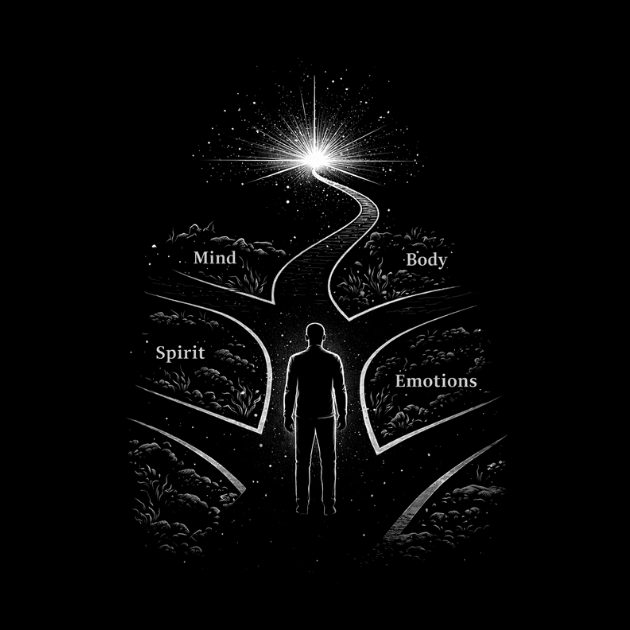
The 4 energy bodies: integrated wisdom across traditions
One of the biggest misconceptions about ancient wisdom is that it was primitive or unsophisticated.
In reality, it was deeply integrated.
Across cultures, geographies, and centuries, the most enduring traditions all shared a common insight:
The human being is a multi-layered system, and none of its layers can be understood in isolation.
They didn’t separate these 4 energy bodies:
- Physical
- Emotional
- Mental
- Spiritual
They treated them as one living whole.
Here’s how this concept looks across ancient wisdom traditions:
Ayurveda
In Ayurveda, health was never just physical.
The body, emotions, thoughts, purpose, diet, rhythm, and environment were all expressions of the same underlying balance.
Disease was seen as an indicator of systemic misalignment, not a mechanical failure.
Traditional Chinese Medicine
Traditional Chinese medicine described life force, or Qi, as something that flows through the body, emotion, and mind simultaneously.
Emotional states weren’t seen as abstract or only existing in the mind.
They were directly linked to organ systems.
Spiritual vitality, emotional harmony, and physical health were inseparable.
Indigenous and tribal cultures
For many indigenous and tribal cultures, identity wasn’t individual.
It was understood as relational to tribe, land, ancestors, and the unseen.
Ritual, movement, story, and shared meaning regulated the nervous system long before the term existed.
Buddhist psychology
In Buddhist psychology, suffering was never treated as a mental defect.
Body sensations, emotions, thoughts, and identity were observed as one experiential field.
Liberation came from awareness and integration, not suppression.
Stoicism and ancient Greek philosophy
Even Stoicism and ancient Greek philosophy saw reason, character, emotional regulation, and purpose as inseparable aspects of humanity.
Philosophy was a way of life practiced in the body, in relationships, and in action.
Wisdom meant living in accordance with nature, not conquering it.
Different cultures. Different metaphors. Same core truth:
To be human is to live in alignment across all 4 dimensions:
Physical. Emotional. Mental. Existential.
For these ancient and indigenous cultures, daily life integrated things such as movement, rituals, community, nature, and storytelling.
Wisdom was shared through lived experience.
Healing addressed the whole system, not isolated symptoms.
Suppressing pieces of yourself wouldn’t be seen as a measure of success.
If you want fulfillment, you need to reconnect with your full humanity.
That starts by acknowledging yourself as a multi-layered being.
What the West optimised, and what it lost
What ancient cultures held as an integrated understanding, the modern world disassembled.
Through this process, humans lost inner coherence but gained power.
In the pursuit of power, the West mastered things like logic, efficiency, control, and scientific knowledge.
We built systems that could predict, standardize, replicate, and outperform.
Then we began asking the same of ourselves.
This narrowed our definition of intelligence.
The body became a machine.
Emotions became distractions.
Spirit became either religion or irrelevance.
What emerged was a culture of hyper-functioning, inwardly fragmented humans.
We became excellent at doing, but lost touch with being.
This inner fragmentation is a natural result of our conditioning.
In most Western education systems, we prioritise cognitive performance and external achievements.
But when we reduce our self-concept to output, we miss out on broader needs such as emotional literacy, nervous system regulation, energy management, meaning-making, and self-awareness at a deeper level.
We train minds, but become untrained as human beings.
So by the time people reach adulthood, many never learned how to listen to their bodies, relate to their feelings, or question inherited definitions of success.
If they’re curious or lucky, they stumble onto these questions later in life.
Otherwise, they live on autopilot, operating in productive misalignment.
We see the consequences of forgetting our humanity all around us:
- Rising burnout, anxiety, and depression
- Chronic fatigue despite “success”
- Loss of purpose in high achievers
- Constant stimulation, little satisfaction
- Identity built on output, not essence
We’re even taught to see these as personal failings when they’re really cultural blind spots.
How to reclaim wisdom without rejecting modern life
We don’t have to romanticise the past or abandon technology to reconnect with our humanity.
Instead of going backwards, we can choose to integrate ancient wisdom with modern capability.
Find ways to humanise our work, our relationships, and our lives as they are today.
Because modern systems are powerful. Technology and science have given us capabilities no previous generation could imagine. But making progress while suppressing our full selves will always lead to that empty feeling.
Real progress incorporates every dimension. That’s how we achieve and sustain optimal performance and how we lead more satisfying lives.
And with the way things are headed—AI and new tech emerging daily—your humanity isn’t just the key to fulfillment. It’s a differentiator that sets you apart.
What the future actually demands
Humanising progress means designing our lives, our work, our relationships, and our systems in a way that accounts for the whole human being.
This is important as we see more tasks become automated or taken over by AI.
High performance and rapid output aren’t the differentiators they once were.
The humans who thrive will be the most integrated among us.
The future belongs to those of us who can:
- Think clearly without becoming detached
- Feel deeply without getting overwhelmed
- Act purposefully without burning out
- Stay energetically grounded despite constant stimulation
What integration looks like in practice
At a high level, reclaiming our humanity changes how we define effectiveness.
Here are a few examples of how this can take shape in daily life:
- Leaders who manage energy, not just time. They understand that when they or their team members are depleted, they won’t make the best decisions. They prioritise rest as much as performance, and expect those they lead to do the same.
- Work that respects human rhythms. Instead of expecting constant output, an integrated workflow includes cycles of focus and recovery. Before the task itself, it prioritises the physical, emotional, mental, and spiritual health of the humans executing the work.
- Education that develops the whole person. This type of schooling sees cognitive skills as just one aspect of a human being. It helps people understand themselves, their inner states, their communities and environments, and their values, alongside building external competence.
- Ambition grounded in congruence. Your goals represent your full humanity, not an attempt to outrun feelings of inadequacy or do what you think is expected of you.
- Success defined by expression, not exhaustion. You stop measuring success by how long you can push or how depleted you are at the end of the day. Instead, apply a more holistic lens to assess whether your efforts are aligned, sustainable expressions of who you are.
Remembering our humanity
Returning to your full humanity is an act of remembrance, not self-improvement.
Because we’re not optimising, just shining light on the dimensions that have always been there.
Stop seeing your humanity as a weakness. Start seeing it as the foundation to build from.
This is how you create deeper fulfillment, gain clarity and energy, and sustain an aligned life.
The next evolution of performance is about remembering how to be human.
If this way of thinking resonates, check out The Inner Edge course. In this guided program, you develop a personalized energy blueprint, integrating physical, mental, emotional, and spiritual health to improve your career and personal life and achieve sustainable performance.

About the author Nicolai Nielsen
I am the bestselling author of 3 books, former McKinsey Academy Associate Partner, and the founder of Potential Academy.
My mission is to raise global consciousness through education and inspiration.


© Nicolai Nielsen 2025